
Frida Kahlo: The Surrealist Queen of Self-Portraits
Within the art community, Frida Kahlo is an impossible name not to know. Born in the early 1900s, the Mexican artist has become one of the most prominent artists, not only from her era, but of all time. Her impact is still realized to this day, and her influence on the art community is infinite. However, while she painted various items and things, she is most known for her self-portraits.
Self portraits, like the name suggests, is a painting of one’s self. Kahlo was not the inventor of the self-portrait, as various famous artists have worked in the craft throughout art history. These artists include Vincent Van Gogh, with his infamous 1889 self-portrait, or Leonardo Da Vinci, with his 1512 work. However, Kahlo differs from them primarily due to her usage of surrealism within her self-portraits. Surrealism is the usage of dream-like scenes, symbolism, and altered reality within art. This type of art style was a staple of Kahlo’s.
Her work “The Two Fridas”, painted in 1939 and currently held by the Museo de Arte Moderno in Mexico City, is a prime example of this. The work features two Fridas, one in lavish white clothing, and another in a more simple dress. The two of them are tied together by a blood vessel, connected directly with the two Fridas’ hearts.
“The Two Fridas” isn’t the only famous piece of hers that uses surrealist strange imagery and symbolism. This style is present, to name a few, in her 1946’s “The Wounded Dear”, her 1932’s “Self Portrait on the Borderline Between Mexico and the United States” and her 1940’s “Thorn Necklace and Hummingbird".
While many might be confused by the seemingly random imagery within her work, her paintings often symbolized ongoing personal issues, her personal identity, her life, or the overall socioeconomic status of the era.
For example, following a 1925 bus accident, Kahlo was left immensely injured. She turned to art during this time, and various imagery in her works reflect that traumatic incident and the injuries that surrounded her, such as her 1944 piece, “The Broken Column”. She also had works that symbolized her Mexican heritage, which could be seen in her most famous work “Thorn Necklace and Hummingbird”. The hummingbird depicted on her is a Mexican symbol of good luck, though some others interpret it as representing the Aztec God of War, Huitzilopochtil, and the internal suffering she had. She painted about her status as an immigrant from Mexico, as depicted in her “Self Portrait on the Borderline Between Mexico and the United States.” She painted about her relationship with Diego Rivera as in her “The Two Fridas”, the two Fridas actually represent two versions of Frida, the one loved by Diego and the one rejected by him.
She also painted about her personal gender identity though she did so in a way that was primarily unconventional for the time. For example, she often painted herself with a faint mustache, dressing up in both men’s and women’s clothing, or with cropped hair. This was quite a stark contrast from how most women were perceived during the era, as traditional values and traditional gender norms were still very much in place. However, following the US’ 19th Amendment granting the women the right to vote, there were more subversions to this traditional status, such as the rise of the flapper girls and overall, more female autonomy. Kahlo’s works concerning gender identity reflect this small, but growing change in the era.
Although she was a respected artist during the era, she still struggled to make ends meet. Her work did not bring her much money and she consistently struggled financially. However, decades following her death, her influence is finally recognized. Her home, located in Coyocán, Mexico City, was made into a museum. Her life was made into a movie in 2002, starring Salma Hayek. Her work now sells for millions, with a self-portrait of hers selling for $54.7 million in 2025, setting the record for highest price sold at a public auction by a Mexican artist. Her significant contribution to surrealism has made it one of the most prominent art forms to this day. With all of this in mind, it can not be understated the prominence and impact that Kahlo holds, as she has forever influenced and changed the world of art.
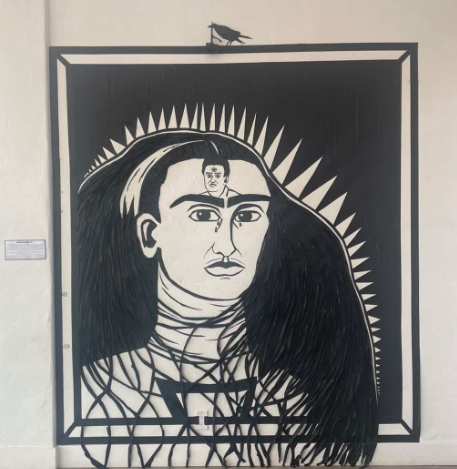
Artist: Armando Franco
I.G.: @adfranco_art
Title: Diego Y Yo
Reimagined Frida Kahlo work with tape currently displayed at 6th Street.